I’m Shumail Ahmed, and I run Wisedtfprints.com. Every week, customers across the UK ask me the same thing. “Should I choose A4 or A3 DTF transfer sheets?” It sounds simple, but the answer depends on how you print, what you print, and how often you print. In this guide, I’ll explain it in plain English, based on real work I do every day. No sales talk. No confusion. Just clear help. By the end, you’ll know exactly which sheet size fits your needs.
What Are DTF Transfer Sheets?
DTF stands for Direct to Film. You print your design on a special film, then press it onto fabric using heat.
People use DTF for:
- T-shirts
- Hoodies
- Tote bags
- Sportswear
- Workwear
DTF works on light and dark fabrics. That’s why it’s popular. What many people miss is this: DTF transfer sheet sizes matter a lot. The size you choose affects layout, cost, waste, and speed.
Understanding A4 and A3 DTF Transfer Sheets
Let’s keep this simple.
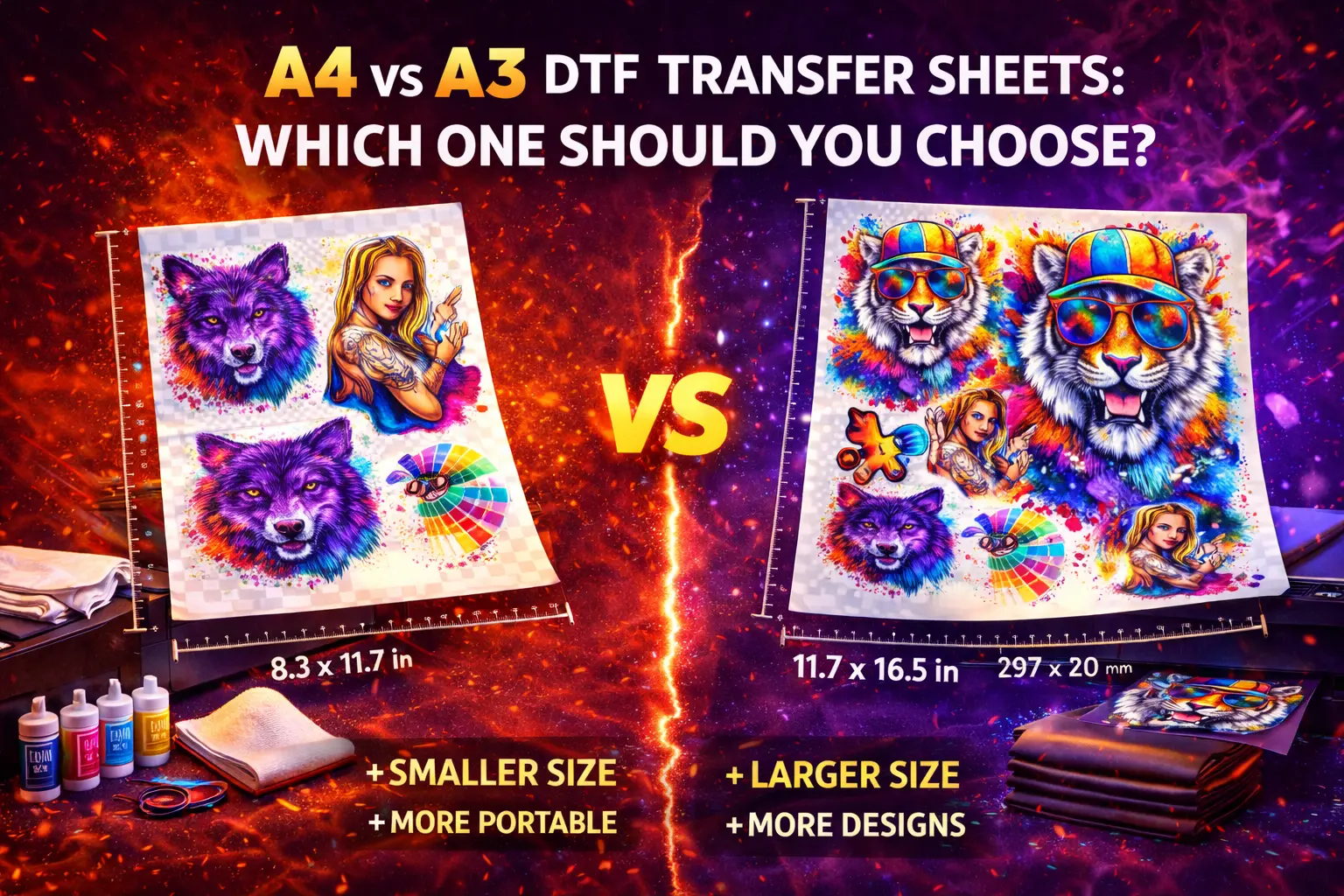
A4 DTF Transfer Sheets
- Size: 210 × 297 mm
- Close to a standard office page
- Easy to handle
- Ideal for small designs
If you print logos, names, or small artworkA4 DTF transfer sheets do the job well.
A3 DTF Transfer Sheets
- Size: 297 × 420 mm
- Double the print space of A4
- Better for larger artwork
- More room for planning
This size difference changes everything. A3 DTF transfer sheets work better for larger artwork, back prints, and multi-design layouts.
A4 vs A3: DTF Print Size Comparison
Here’s a clear DTF print size comparison based on daily use.
Space and Layout
A4 limits how much you can print. A3 gives you more freedom.
With A3, you can:
- Fit larger chest prints
- Place multiple logos on one sheet
- Plan artwork better
This helps with print layout planning and artwork placement.
Small vs Large Designs: What Works Best?
When A4 Makes Sense
Choose A4 DTF transfer sheets if you:
- Print left chest logos
- Print sleeve designs
- Print small text
- Print one design at a time
A4 works well for:
- Small brands
- Home setups
- Beginners
It keeps things simple and controlled.
When A3 Is the Better Choice
Choose A3 DTF transfer sheets if you:
- Print back designs
- Print wide artwork
- Print multiple designs
- Run bulk orders
A3 suits:
- Growing brands
- Print shops
- Side hustles scaling up
This is where small vs large designs really matter.
Cost Per Print: The Real Difference
Many people think A4 is cheaper. That’s not always true.
A4 Cost Reality
- Lower sheet price
- Higher cost per design
- More unused space
If you print one logo per A4 sheet, waste adds up fast.
A3 Cost Reality
- Higher sheet price
- Lower cost per print
- Better space use
With A3, you can place several designs on one sheet.
That saves money over time.
Print Waste Reduction and Smarter Printing
Waste hurts profits. I see this often.
A4 sheets:
- Leave empty space
- Increase print waste
A3 sheets:
- Allow tighter layouts
- Support print waste reduction
When customers switch to A3, they often reduce waste by half.
Production Efficiency in Real Orders
Speed matters when orders stack up.
A4 printing:
- More sheets
- More handling
- Slower output
A3 printing:
- Fewer sheets
- Faster pressing
- Better production efficiency
If you press 50 shirts, this difference is huge.
Choosing the Right DTF Transfer Size
Let’s make this easy.
Choose A4 If:
- You print small logos
- You work from home
- You handle low volume
- You want simple control
Choose A3 If:
- You print full designs
- You offer custom DTF transfers
- You want better margins
- You plan to grow
This is the heart of choosing the right DTF transfer size.
DTF Sheet Size Guide for Apparel Printing
Here’s a quick DTF sheet size guide for apparel printing sizes:
- Left chest logo: A4
- Sleeve print: A4
- Back print: A3
- Hoodie front: A3
- Mixed designs: A3
This guide saves many customers from trial and error.
Heat Press Transfers and Sheet Size
Heat press transfers need space.
Crowded prints cause issues.
With A4:
- Less room to adjust
- Higher risk of mistakes
With A3:
- More control
- Easier alignment
This improves press results and reduces reprints.
Gang Sheet Printing: Where A3 Wins
If you use gang sheet printing, A3 is a clear winner.
Gang sheets let you:
- Combine many designs
- Print once
- Press many times
Many brands now use custom DTF gang sheets to save time.
Custom Orders and Business Growth
As your brand grows, needs change. Most clients start with A4. Many switch to A3 later.
Why?
- Larger orders
- Better planning
- Faster fulfilment
A3 supports long-term growth.
Real Example From My Print Room
One customer printed 100 shirts weekly. They used A4 sheets. They needed 100 prints. We switched them to A3 gang sheets. They used 45 sheets instead. Their costs dropped. Their time saved increased. That’s the real value.
Which Size Do I Recommend?
I’ll be honest. If you print for fun or learning, start with A4. If you print to sell, move to A3 sooner. There’s no wrong choice. There’s only the right fit for your work.
Final Thoughts From Me
DTF printing rewards smart choices. Sheet size plays a big role. A4 offers control and ease. A3 offers speed and savings.
Think about:
- Your design size
- Your order volume
- Your future plans
Choose once. Print smarter. Grow faster.
Read more: DTF Transfer Not Sticking? Troubleshooting Guide
Frequently Asked Questions
Can I use both A4 and A3 DTF transfer sheets for the same clothing order?
Yes, many printers do this. I often see brands use A4 DTF transfer sheets for small chest logos and A3 DTF transfer sheets for back prints in the same order. This mix helps control cost while keeping print quality consistent across garments.
Does switching from A4 to A3 affect press quality or fabric feel?
No, the press quality stays the same if the film and settings remain correct. The difference comes from layout space, not the transfer result. A3 sheets simply give more room for artwork placement, which can reduce pressing mistakes on larger designs.
Is A3 better than A4 for long-term printing work?
For most growing setups, yes. When orders increase, A3 DTF transfer sheets improve production efficiency and reduce waste. If you print often or plan to scale, A3 usually becomes the more practical option over time.